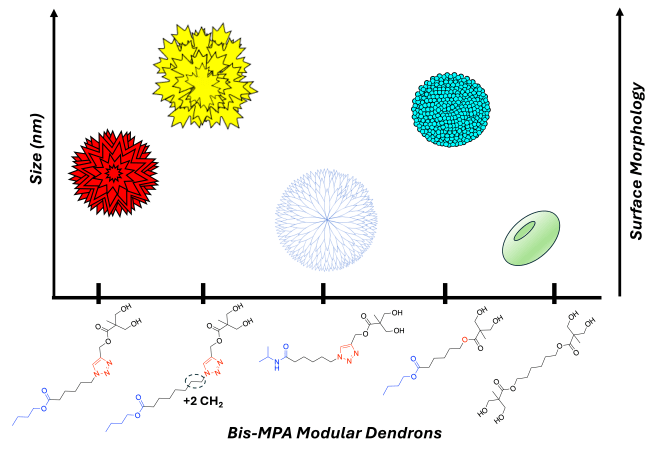
Precise control over the physicochemical and biological properties of colloidal particles is essential for the rational design of functional soft materials. In this work, we report a simple and scalable strategy for generating modular dendron particles (MDPs) through the self-assembly of fully characterized small-molecule Bis-MPA dendrons that act as programmable molecular building blocks for colloidal particle formation. By systematically varying three structural domains—the inner functionality, methylene spacer length, and outer connector—we achieve tunable formation of MDPs ranging from nano- to microscale dimensions. Upon solvent evaporation under mild drying conditions, pre-assembled MDPs act as structure-directing seeds that guide the emergence of hierarchical surface morphologies with spiky, scaly, or spherical protrusions, depending on dendron architecture. Importantly, these assemblies exhibit good biocompatibility toward non-tumoral bronchial epithelial (NL-20) cells while displaying selective cytotoxicity toward Neuro-2a neuroblastoma cells, demonstrating that dendron molecular architecture alone can govern particle size, morphology, and biological response without external drug loading. Collectively, these findings highlight modular Bis-MPA dendrons as versatile building blocks for directing particle size, morphology, and biological response through controlled self-assembly and evaporation-driven structuring.
https://doi.org/10.3390/nano16070406
: Publications
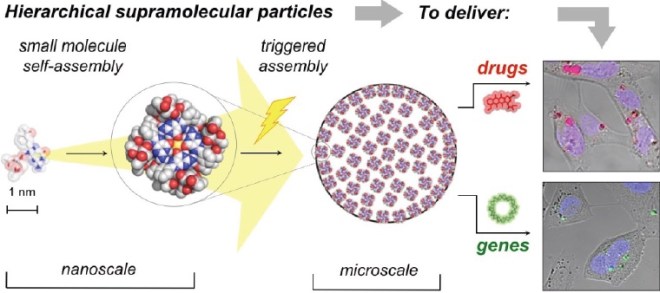
Supramolecular hacky sacks (SHS) are a distinct class of self-assembled colloidal particles derived from guanosine (G) derivatives, engineered to support a wide range of cellular and therapeutic functions. In this study, we examine how variations in G-derivative composition influence SHS cellular uptake, intracellular trafficking, and functional efficacy. Confocal microscopy and flow cytometry reveal that uptake is highly dependent on particle composition, indicating selective engagement with specific cellular mechanisms. We show that SHS particles are biocompatible carriers capable of delivering both small molecules and genetic material: they successfully encapsulate and release doxorubicin with enhanced cytotoxic effects, and enable plasmid transfection with sustained expression of fluorescent proteins. These findings position SHS particles as a highly adaptable and effective supramolecular platform for drug and gene delivery. Their intrinsic biodegradability, ease of preparation, and tunable bioactivity highlight their strong potential for advancing biomedical applications.
https://doi.org/10.1021/acsabm.5c00201
Negrón LM, Vázquez-Rosa E, Belfleur L, Díaz TL, Madera-Soto B, Vega IE, Rivera JM. Guanosine-Based Supramolecular Particles for Enhanced Drug and Gene Delivery in Cell Culture. ACS Appl Bio Mater. 2025 Jul 21;8(7):5625-5633.
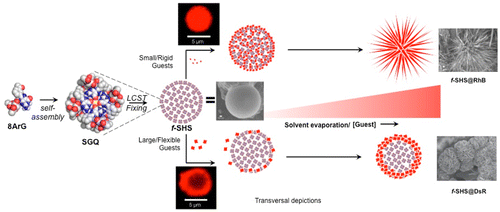
Nanoflowers (NFs) are flowered-shaped particles with overall sizes or features in the nanoscale. Beyond their pleasing aesthetics, NFs have found a number of applications ranging from catalysis, to sensing, to drug delivery. Compared to inorganic based NFs, their organic and hybrid counterparts are relatively underdeveloped mostly because of the lack of a reliable and versatile method for their construction. We report here a method for constructing NFs from a wide variety of biologically relevant molecules (guests), ranging from small molecules, like doxorubicin, to biomacromolecules, like various proteins and plasmid DNA. The method relies on the encapsulation of the guests within a hierarchically structured particle made from supramolecular G-quadruplexes. The size and overall flexibility of the guests dictate the broad morphological features of the resulting NFs, specifically, small and rigid guests favor the formation of NFs with spiky petals, while large and/or flexible guests promote NFs with wide petals. The results from experiments using confocal fluorescence microscopy, and scanning electron microscopy provides the basis for the proposed mechanism for the NF formation.
https://pubs.acs.org/doi/abs/10.1021/acs.langmuir.5b03946
Negrón LM, Díaz TL, Ortiz-Quiles EO, Dieppa-Matos D, Madera-Soto B, Rivera JM. Organic Nanoflowers from a Wide Variety of Molecules Templated by a Hierarchical Supramolecular Scaffold. Langmuir. 2016 Mar 15;32(10):2283-90.
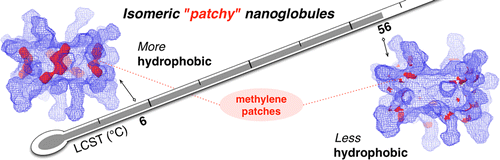
We describe precise supramolecules that enable the evaluation of the effective hydrophobicity of amphiphilic or “patchy” nanoglobular systems. These supramolecules exhibit the lower critical solution temperature phenomenon, which provides a quantitative measure of their effective hydrophobicity. Specifically, two isomeric 8-aryl-2′-deoxyguanosine derivatives with a transposed pair of methylene groups self-assemble into hexadecameric nanoglobular supramolecular G-quadruplexes (SGQs) that show large differences in their transition temperatures as determined by turbidity and differential scanning calorimetry studies. Molecular modeling studies suggested that differential clustering of the hydrophobic patches on the surface is responsible for the striking differences between the two isomeric supramolecules.
https://doi.org/10.1021/ja401373h
Negrón LM, Meléndez-Contés Y, Rivera JM. Patchy supramolecules as versatile tools to probe hydrophobicity in nanoglobular systems. J Am Chem Soc. 2013 Mar 13;135(10):3815-7.

