Research Overview
Our research program focuses on the design of modular organic nanomaterials through controlled self-assembly and their integration into functional soft materials for applications in drug delivery, biomaterials, and nanotechnology.
Modular Dendron Particles (MDPs) for Drug Delivery and Molecular Encapsulation
Description:
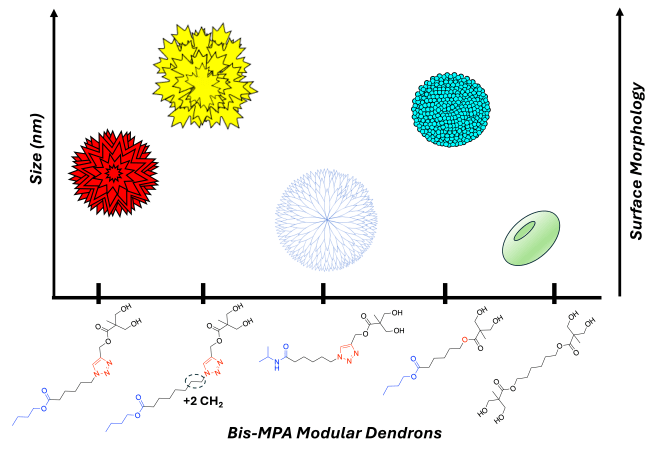
Our research focuses on the design and development of modular dendron-based nanoparticles (MDPs) as versatile platforms for drug delivery and molecular encapsulation. These systems are constructed from well-defined small organic building blocks that undergo stimuli-responsive self-assembly to form colloidal particles with tunable physicochemical properties.
A key aspect of this work is the ability of MDPs to interact with and solubilize hydrophobic molecules in aqueous environments, enabling the formulation of compounds that are otherwise poorly water-soluble. This approach provides a promising strategy for improving the delivery and bioavailability of therapeutically relevant molecules.
Importantly, these nanoparticles are generated through simple, surfactant-free processes, allowing for precise control over structure, morphology, and function. Ongoing efforts explore the relationship between molecular design and particle behavior, including size, morphology, and biological response.
Hydrogel Nanocomposites Based on MDPs (pNIPAM and Alginate Systems)
Description:
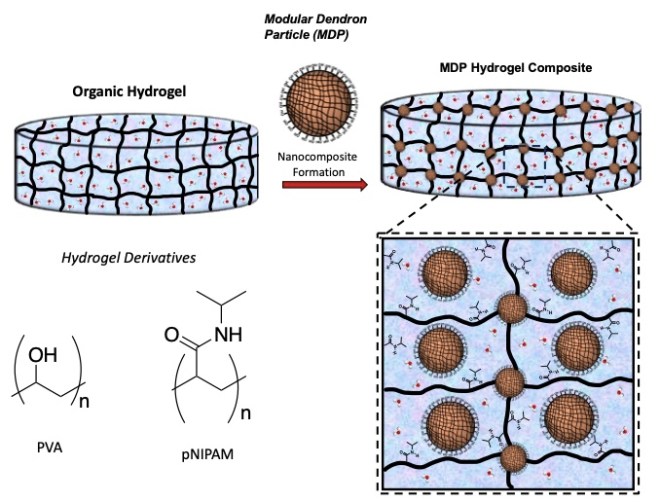
A second research direction in our laboratory explores the integration of modular dendron nanoparticles (MDPs) with polymeric hydrogels to generate functional nanocomposite materials. In these systems, MDPs act as molecular-level crosslinking elements, enabling the formation of hybrid materials that combine the structural properties of hydrogels with the functionality of nanoscale building blocks.
We investigate hydrogel platforms such as poly(N-isopropylacrylamide) (pNIPAM) and alginate, focusing on how their interaction with MDPs influences mechanical properties, structural organization, and encapsulation behavior.
These nanocomposites provide a versatile framework for applications in:
- controlled release systems
- environmental remediation
- biomaterials and soft matter design
Current work aims to understand the molecular interactions governing nanoparticle–polymer integration, while developing scalable strategies for constructing functional soft materials.

